
Latest News
Articles, opinion pieces, white papers, reports and news releases

New Guidance for AI Adoption
Resource | 21 October 2025
The Department of Industry, Science and Resources (DISR) has released Guidance for AI Adoption to enable safe and responsible AI across Australian industry. The Guidance for AI Adoption: Foundations and supporting templates were developed by Gradient Institute with the National AI Centre.

Gradient Institute Response to the Productivity Commission's Interim Recommendations on AI
Submission | 25 September 2025
Gradient Institute has responded to the Productivity Commission's interim report on 'Harnessing data and digital technology', arguing that its proposed regulatory approach to AI applies conventional governance principles to a fundamentally unconventional technology that may lead to a paradigm shift in how society operates.
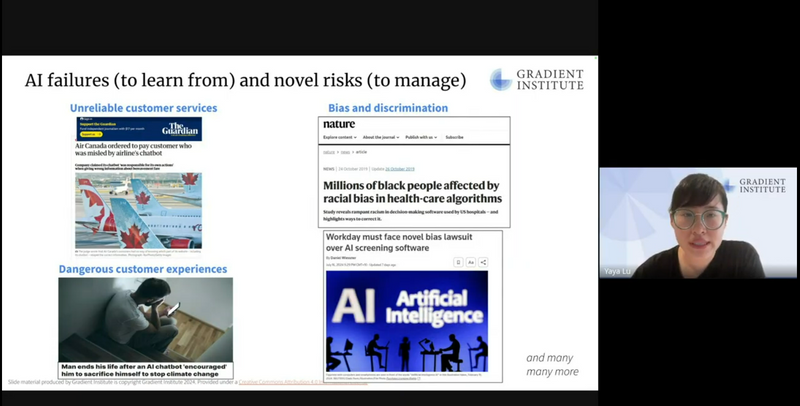
Gradient Institute provides Responsible AI Support to Australian Not-for-Profits
Education | 22 August 2025
Australian not-for-profit organisations (NFPs)—organisations with socially-aligned motivations, knowledge, and experience—could significantly amplify their impact by using artificial intelligence (AI) capabilities in a safe and responsible way.
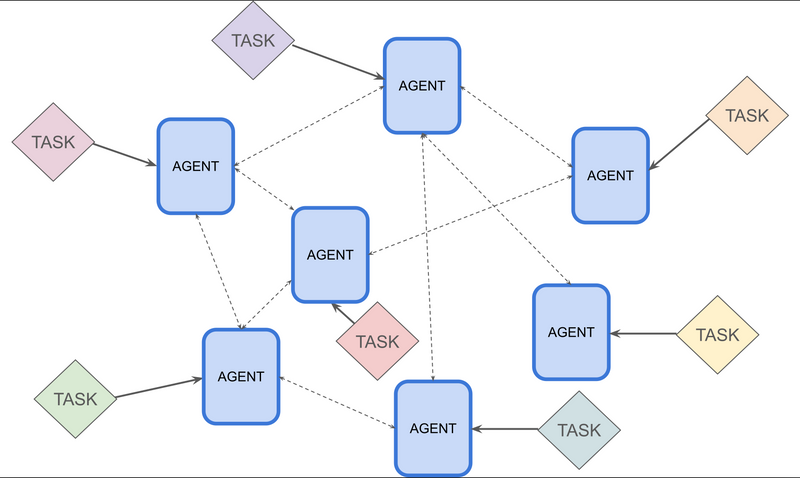
New Report Analysing Multi-Agent Risks
Report | 29 July 2025
Organisations are starting to adopt AI agents based on large language models to automate complex tasks, with deployments evolving from single agents towards multi-agent systems. While this promises efficiency gains, multi-agent systems fundamentally transform the risk landscape rather than simply adding to it. A collection of safe agents does not guarantee a safe collection of agents –...
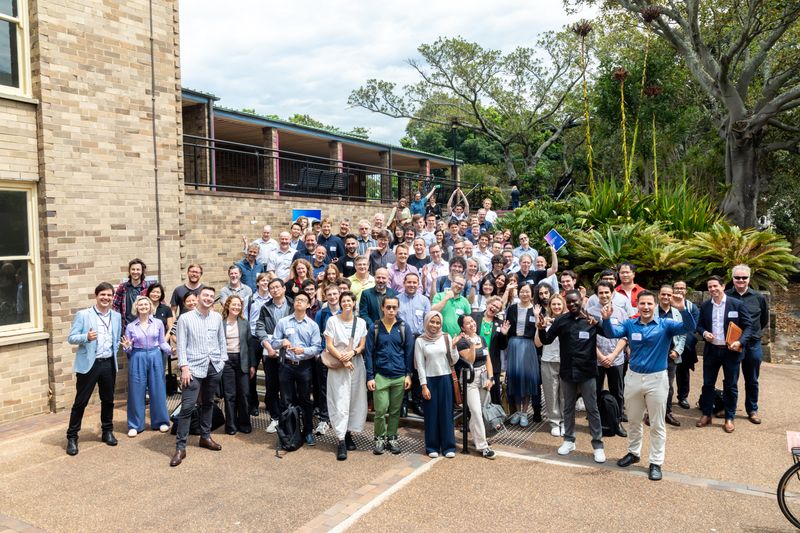
Australian AI Safety Forum 2024
Event | 18 November 2024
On 7-8 November 2024 the inaugural Australian AI Safety Forum 2024 was held at the Sydney Knowledge Hub at the University of Sydney, bringing together researchers, policymakers, and industry representatives to discuss AI Safety as documented in the Interim International Scientific Report on the Safety of Advanced AI.

Australian Government releases mandatory AI guardrails paper and voluntary AI safety standard
Regulation | 5 September 2024
The Australian Government has released two key documents aimed at promoting safe and responsible AI in Australia, with Gradient Institute contributing expertise to their development.

Alberto Chierici and Liam Carroll join Gradient Institute team
News | 27 August 2024
Gradient Institute is delighted to welcome Alberto and Liam to the team!

National framework for the assurance of AI in government
Regulation | 21 June 2024
The Australian Government's new AI framework draws on key contributions from Gradient Institute.

Bill Simpson-Young presents to Senate committee
News | 10 May 2024
Gradient Institute CEO Bill Simpson-Young presented to the Australian Senate's Select Committee on Adopting Artificial Intelligence (AI) in May 2024.

Bill Simpson-Young appointed to AI Expert Group.
News | 14 February 2024
Bill Simpson-Young, Chief Executive of Gradient Institute, has been appointed to the federal government’s temporary AI Expert Group.

Investigating Manipulative Applications of Generative AI
Report | 8 December 2023
With support from the Minderoo Foundation, Gradient Institute is exploring how bad actors could leverage the latest pre-trained language models for personalised persuasion and manipulation.

Gradient Institute Receives Donation from Cadent for AI Safety Research
News | 9 November 2023
Gradient Institute has received a donation from Cadent, an ethical technology studio, to develop research on technical AI Safety.
Gradient Institute policy recommendations for the AI Safety Summit
Submission | 27 October 2023
Gradient Institute has prepared a policy paper offering recommendations for the AI Safety Summit, which is to be hosted by the UK Prime Minister Rishi Sunak on the 1st and 2nd of November.

Telstra Foundation supports Gradient Institute research towards safer mental health chatbots
News | 16 August 2023
Telstra Foundation, through its Young & Connected Fund, has provided Gradient Institute with a seed grant to work towards the safe and effective use of AI and Large Language Models (LLM) in mental health chatbots. Gradient, with its technical expertise in the safe and reponsible use of AI, will use the seed grant to work with mental health experts, young people and others to develop the scope...

Gradient Institute response to AI regulation discussion paper
Submission | 1 August 2023
Gradient Institute submitted a response to the Department of Industry, Science and Resources' discussion paper “Safe and Responsible AI in Australia”.

New guidance to help businesses implement responsible AI
Report | 22 June 2023
Gradient Institute, in collaboration with Australia's National Artificial Intelligence Centre (hosted by CSIRO), has released a report that outlines practical measures for businesses to adopt Responsible Artificial Intelligence.

Gradient Institute delivers Generative AI risk control training courses
Education | 6 June 2023
Many companies are starting to use applications that use generative AI technologies such as large language models (LLMs). They often know about the risks such as inaccurate results, bad behaviour and privacy/security issues but they struggle in knowing how to control those risks in their organisation. Gradient Institute now offers training courses (2 hours, half-day and full-day) to help...

Regulators urged to monitor the AI power struggle closely for potential risks
Regulation | 1 May 2023
Dr. Tiberio Caetano, co-founder and chief scientist of Gradient Institute, warns that regulators need to start paying attention to anyone using vast amounts of computer power in machine learning to prevent “bad actors” from creating harmful new AI systems.

Gradient Fellow Chris Dolman awarded Actuary of the Year
News | 15 September 2022
Gradient Institute Fellow Chris Dolman has been awarded Actuary of the Year by the Actuaries Institute of Australia. Some excerpts from the official announcement:

Australia's original disruptive festival is back for 2022
Event | 24 August 2022
We're excited for this important event run by our long-time collaborators The Ethics Centre! Truth, trust, tech, tattoos, and taboos: Australia’s original disruptive festival, the Festival of Dangerous Ideas returns live and in-person to Carriageworks, Sydney 17–18 September, 2022.

Banking Finance + Oath (BFO) AI-driven marketing in financial services
Education | 9 June 2022
The BFO Young Ambassadors collaborated with Gradient Institute to investigate the ethical concerns surrounding the use of AI in financial services. While some areas of the industry, such as credit scoring, have gained awareness of AI ethics, little attention has been given to AI-driven marketing. Developing a thorough understanding of the ethical considerations will help financial services...

Yaya Lu joins Gradient Institute as Senior Consultant
News | 2 June 2022
Yaya’s background includes researcher and business analyst in the Australian Public Service, focusing on generating user-centric outputs to address Whole-of-Government and agency needs. With a degree in Software Engineering (Honours) from The Australian National University she is a passionate advocate for bridging the gap between understanding technology and the people who use it, as well as...
Policy submission on the regulation of AI and automated decision making
Submission | 24 May 2022
Gradient Institute submitted a response to the Department of the Prime Minister and Cabinet’s Digital Technology Taskforce Issues Paper “Positioning Australia as a Leader in Digital Economy Regulation – Automated Decision Making and AI Regulation”.

Future.NSW
Event | 4 May 2022
Future.NSW presented by NSW Government held their thought-leadership event on the 2nd May, 2022. The event brought together the public, the private sector, business and industry leaders and experts that help shape NSW Government. NSW Government supports the building of a smarter, customer centric and a fully digital NSW. Working together with NSW residents, the private sector, industry and...

Caution: metaverse ahead
Position | 21 April 2022
Gradient Institute’s Chief Practitioner, Lachlan McCalman wrote this latest blog post about the metaverse on Medium. The post argues that the metaverse has the potential to have a profound impact on the world, and as a result, we would be wise to plan conservatively...

Gradient Institute Awarded Linkage Grant
News | 12 April 2022
Our Linkage Grant Proposal “Socially Responsible Insurance in the Age of Artificial Intelligence” has been approved by the Australian Research Council.

De-risking automated decisions
Report | 16 March 2022
Today, in collaboration with Minderoo Foundation, we are releasing a report on de-risking automated decisions, which includes practical guidance for AI governance and AI risk management.

AI Impact Control Panel
Resource | 16 March 2022
In partnership with Minderoo Foundation, Gradient Institute has released the first version of our AI impact control panel software. This tool helps decision-makers balance and constrain their system’s objectives without having to be ML experts.

Designing a practical approach to AI fairness
Explainer | 22 February 2022
Gradient Institute, along with collaborators from ServiceNow, Vector Institute and The University of Tübingen, just published an article in the January edition of IEEE Computer laying out conceptual foundations for practical assessment of AI fairness.

Machine learning helps find links between youth well-being and academic success
News | 17 February 2022
In a first-of-its-kind study published in Scientific Reports, machine learning researchers at Gradient Institute, working in partnership with psychology researchers at the Australian National University, have found significant evidence for causal links between students’ self reported well-being and academic outcomes.
The Responsible AI Index report has launched
Report | 14 October 2021
The Responsible AI Index report is a study of over 400 Australian-based organisations and their awareness of, intentions around, and use of Responsible AI practices. This report, a first in Australia of its kind, was launched in partnership with IAG, Telstra, Fifth Quadrant CX, and Ethical AI Advisory.

Welcome to the Ethical AI Advisory team
News | 6 October 2021
We are excited to announce that Gradient Institute and Ethical AI Advisory have joined together! We have been working together as partners for the last year and realised how complementary we were – with Gradient working on the technical aspects of ensuring AI is used responsibly and Ethical AI Advisory working on the organisational and governance aspects of this.
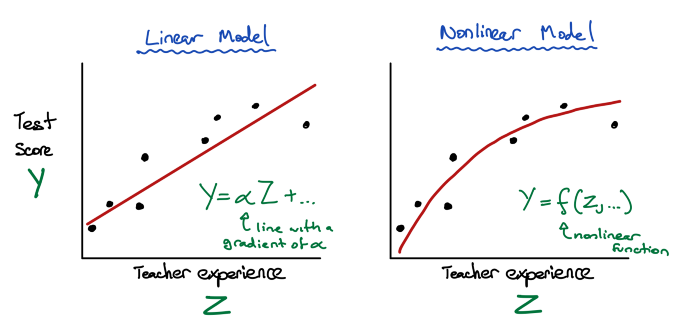
Machine learning as a tool for evidence-based policy
Explainer | 23 July 2021
In this article, Gradient’s Dan Steinberg and Finn Lattimore show how machine learning can be used for evidence-based policy. They show how it can capture complex relationships in data, helping mitigate bias from model mis-specification and how regularisation can lead to better causal estimates.

AI-LEAP Call for Papers
Event | 12 July 2021
AI-LEAP is a new Australia-based conference aiming at exploring Artificial Intelligence (AI) from a multitude of perspectives: Legal, Ethical, Algorithmic and Political (LEAP). It draws broadly on computer science, social sciences, and humanities to provide an exciting intellectual forum for a genuinely interdisciplinary exchange of ideas on what is one of the most pressing issues of our time....
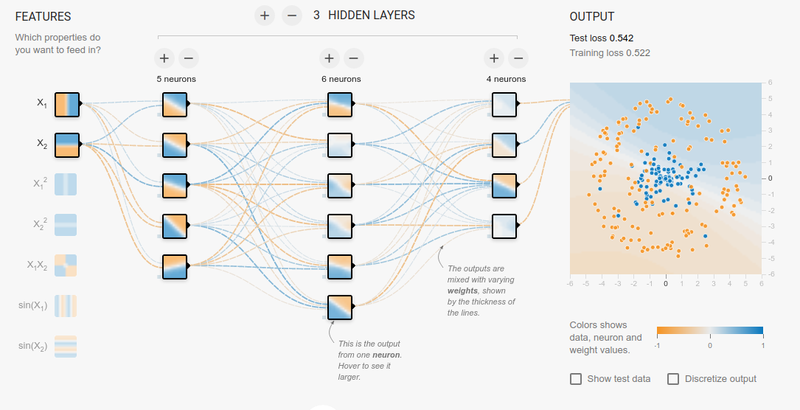
Gradient provides AI Primer for National AI Summit
Education | 19 June 2021
At the request of the Australian Government’s Department of Industry, Science, Energy and Resources, Gradient Institute provided an interactive “Artificial Intelligence Primer” training session for attendees at the Techtonic 2.0 National AI Summit. This was to help attendees of the summit:
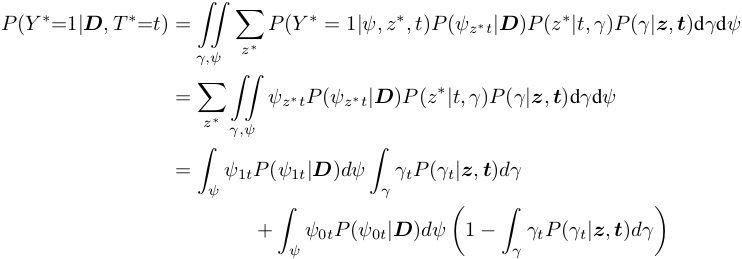
Causal Inference with Bayes Rule
Explainer | 27 April 2021
In this post we explain a Bayesian approach to inferring the impact of interventions or actions. We show that representing causality within a standard Bayesian approach softens the boundary between tractable and impossible queries and opens up potential new approaches to causal inference. This post is a detailed but informal presentation of our Arxiv papers: Replacing the do calculus with Bayes...

Fairness assessment framework for AI systems in finance
Resource | 15 April 2021
Gradient Institute’s Chief Practitioner, Lachlan McCalman, describes our collaborative work with the Monetary Authority of Singapore and industry partners to develop a practical AI Fairness assessment methodology.

Using harms and benefits to ground practical AI fairness assessments in finance
Education | 4 March 2021
Gradient’s Chief Practitioner Lachlan McCalman and Principal Researcher Dan Steinberg presented a tutorial, together with our colleagues from Element AI, at the ACM Fairness Accountability and Transparency Conference (FAccT 2021) on 4 March 2021. You can watch a video recording of the full tutorial below.

Preventing AI from deepening social inequality
Explainer | 13 January 2021
An article in The Conversation by Gradient’s Tiberio Caetano and Bill Simpson-Young discussing a technical paper co-written with Australian Human Rights Commission, Consumer Policy Research Centre, CHOICE and CSIRO’s Data61.

Monetary Authority of Singapore announces success of Veritas Initiative phase 1
News | 6 January 2021
The Monetary Authority of Singapore (MAS) announced the successful conclusion of the first phase of the Veritas initiative which saw the development of the fairness assessment methodology in credit risk scoring and customer marketing. These are the first two use cases to help financial institutions validate the fairness of their Artificial Intelligence and Data Analytics (AIDA) solutions...
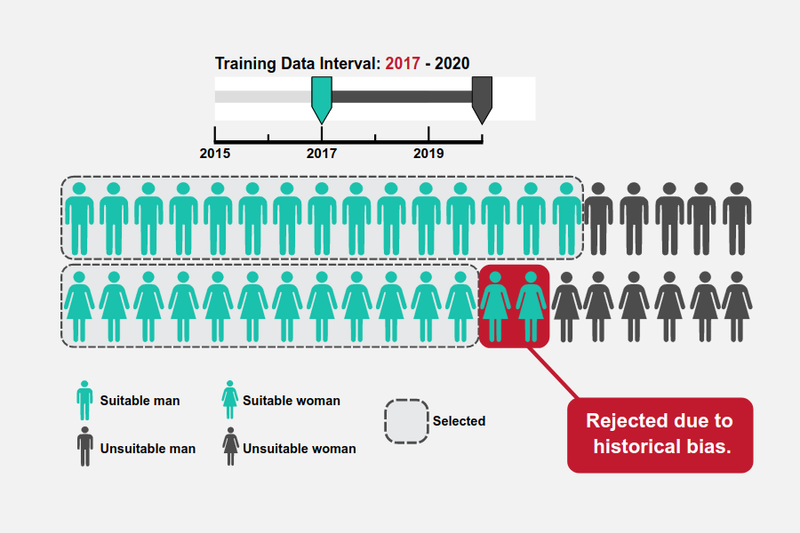
Addressing Algorithmic Bias in AI
Report | 24 November 2020
With companies increasingly using AI for decision making in everything from pricing to recruitment, “Addressing the problem of algorithmic bias”, explores how these decision-making systems can result in unfairness.
Turbocharging ethical AI in Australia
News | 23 September 2020
AI is the fastest growing technology sector in the world with more than US$35 billion invested in 2019, an 18 per cent increase on 2018 (IDC, 2020). About 40% of organisations are predicted to use AI by the end of this year.**
Ethics of insurance pricing
Report | 4 August 2020
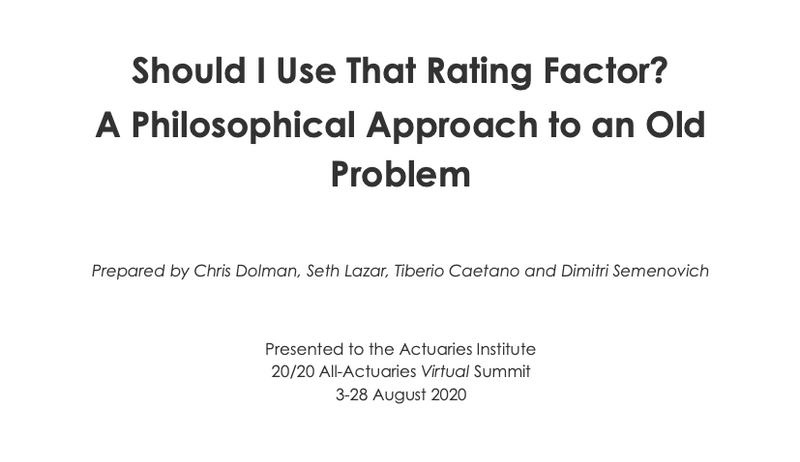
Gradient Institute Fellows Chris Dolman, Seth Lazar and Dimitri Semenovich, alongside Chief Scientist Tiberio Caetano, have written a paper investigating the question of which data should be used to price insurance policies. The paper argues that even if the use of some “rating factor” is lawful and helps predict risk, there can be legitimate reasons to reject its use. This suggests insurers...
Submission to Australian Human Rights Commission
Submission | 25 May 2020
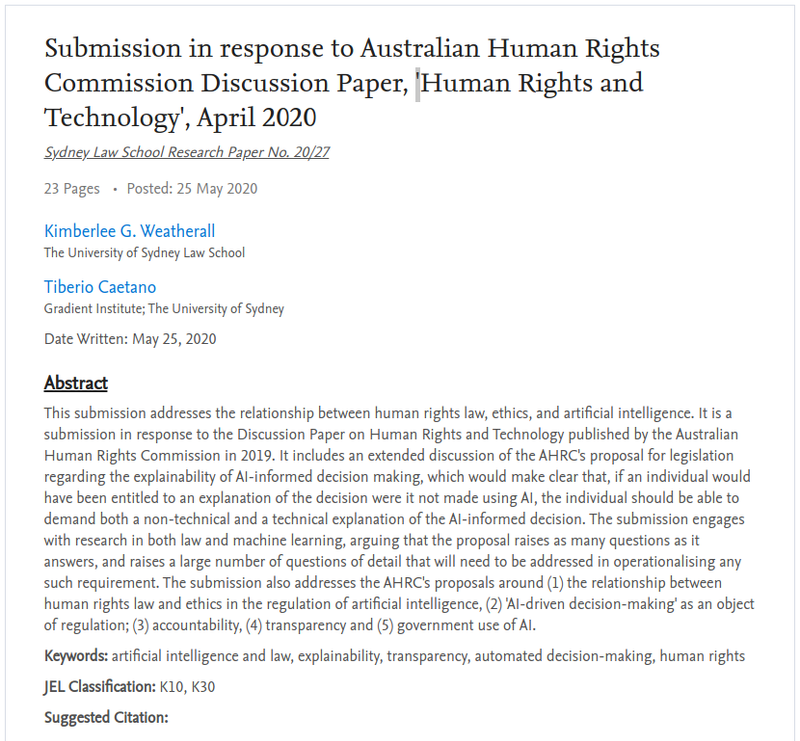
Gradient Institute Fellow Kimberlee Weatherall and Chief Scientist Tiberio Caetano have written a submission to the Australian Human Rights Commission on their “Human Rights and Technology” discussion paper.

Converting ethical AI principles int practice
Position | 11 May 2020
Our Chief Scientist, Tiberio Caetano, has summarised some lessons we have learned over the last year creating practical implementations of AI systems from ethical AI principles. Tiberio is a member of the OECD’s Network of Experts in Artifical Intelligence and wrote this article for the network’s blog.
Fast methods for fair regression
Explainer | 25 February 2020
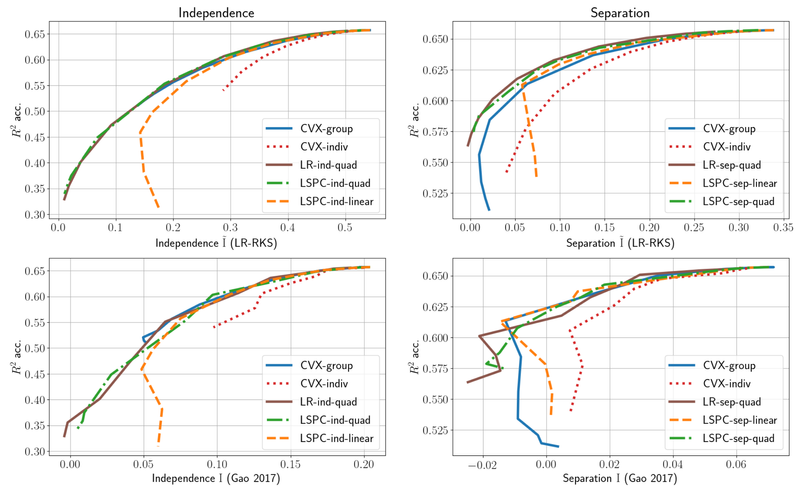
Gradient Institute has written a paper that extends the work we submitted to the 2020 Ethics of Data Science Conference on fair regression in a number of ways. First, the methods introduced in the earlier paper for quantifying the fairness of continuous decisions are benchmarked against “gold standard” (but typically intractable) techniques in order to test their efficacy. The paper also adapts...
Using probabilistic classification to measure fairness for regression
Explainer | 18 February 2020
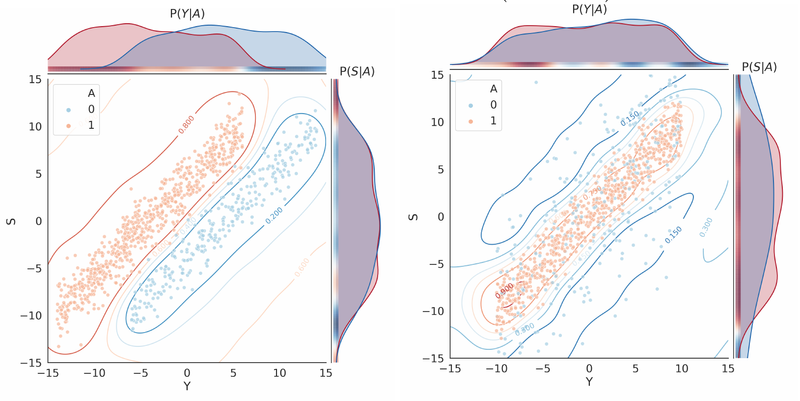
Gradient Institute have released a paper (to be presented at the 2020 Ethics of Data Science Conference) studying the problem of how to create quantitative, mathematical representations of fairness that can be incorporated into AI systems to promote fair AI-driven decisions.
Gradient Institute Chief Scientist appointed to OECD advisory group on artificial intelligence
News | 15 January 2020
Gradient Institute Chief Scientist Tiberio Caetano has been appointed to the OECD Network of Experts on AI (ONE AI). The expert group provides policy, technical and business input to inform OECD analysis and recommendations. It is a multi-disciplinary and multi-stakeholder group.

Causal inference with Bayes rule
Report | 13 December 2019
Finn Lattimore, a Gradient Principal Researcher, has published her work on developing a Bayesian approach to inferring the impact of interventions or actions. The work, done jointly with David Rohde (Criteo AI Lab), shows that representing causality within a standard Bayesian approach softens the boundary between tractable and impossible queries and opens up potential new approaches to causal...
Practical challenges for ethical AI
Report | 3 December 2019
Gradient has released a White Paper examining four key challenges that must be addressed to make progress towards developing ethical artificial intelligence (AI) systems. These challenges arise from the way existing AI systems reason and make decisions. Unlike humans, AI systems only consider the objectives, data and constraints explicitly provided by their designers and operators.
Our response to 'Artificial Intelligence: Australia's Ethics Framework'
Submission | 6 June 2019
Gradient Institute has made a submission as part of the public consultation on the discussion paper “Artificial Intelligence: Australia’s Ethics Framework (A Discussion Paper)”. The paper was developed by CSIRO’s Data61 and released by the Department of Industry, Innovation and Science on 5 April 2019. You can find our submission here.

Whose ethics?
Position | 25 March 2019
We at the Gradient Institute are often asked who decides the particular ethical stance encoded into an ethical AI system. In particular, because we work on building such systems, the question also takes the form of “whose ethics” we will encode into them. Our Chief Practitioner, Lachlan McCalman, has written a blog post to address such questions.

Ignorance isn't bliss
Explainer | 6 December 2018
Societies are increasingly, and legitimately, concerned that automated decisions based on historical data can lead to unfair outcomes for disadvantaged groups. One of the most common pathways to unintended discrimination by AI systems is that they perpetuate historical and societal biases when trained on historical data. Two of our Principal Researchers, Simon O’Callaghan and Alistair Reid,...

Helping machines to help us
Position | 6 December 2018
Societies are increasingly, and legitimately, concerned that automated decisions based on historical data can lead to unfair outcomes for disadvantaged groups. One of the most common pathways to unintended discrimination by AI systems is that they perpetuate historical and societal biases when trained on historical data. Two of our Principal Researchers, Simon O’Callaghan and Alistair Reid,...